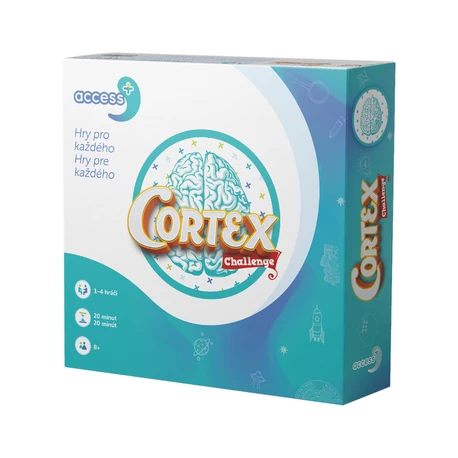
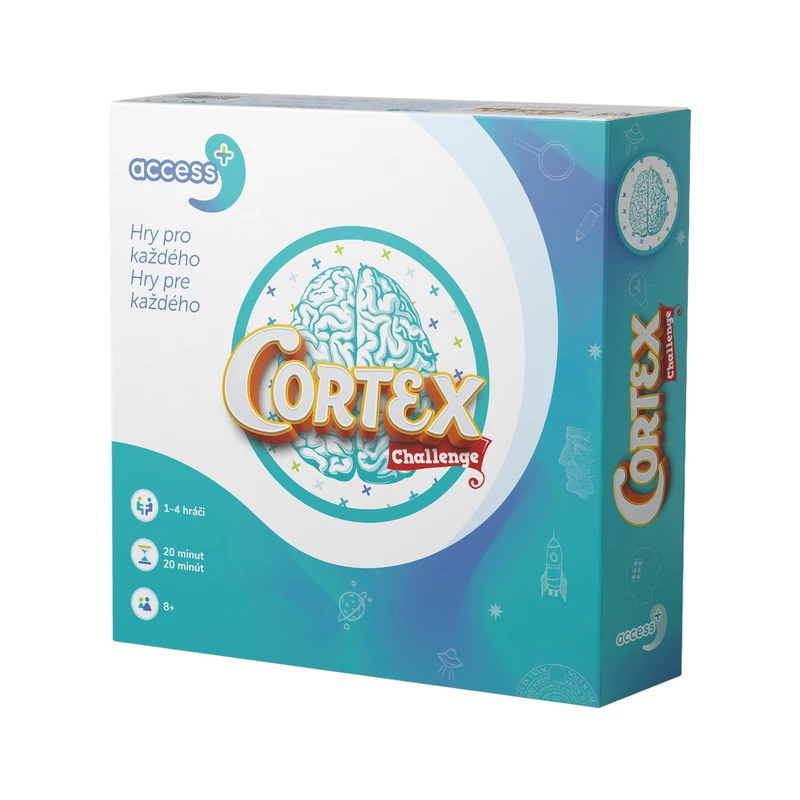
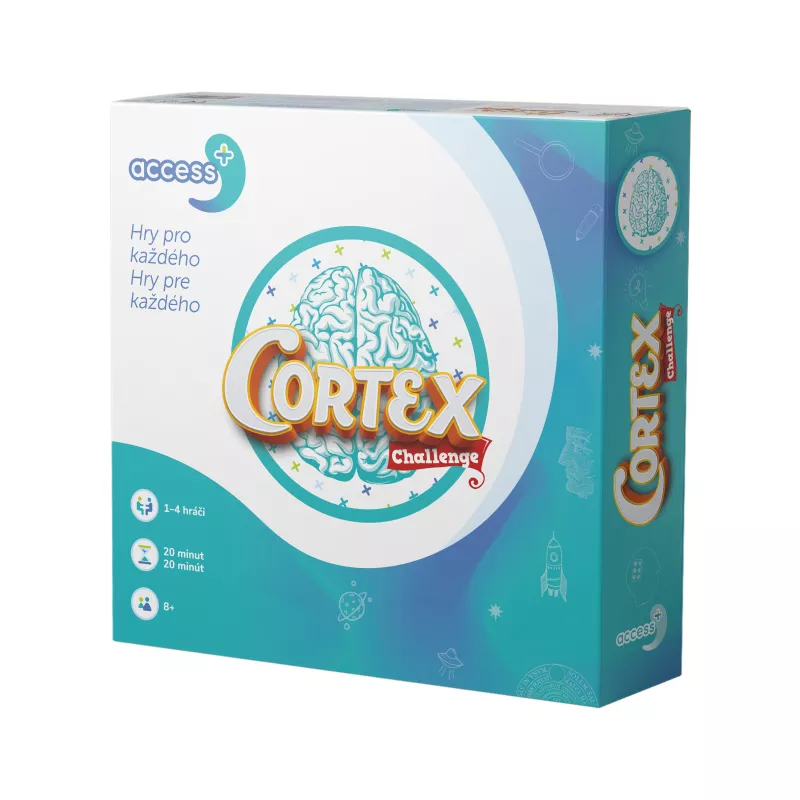
The Access+ game series is specially adapted to support the correction of cognitive impairments.
Games are a tool that stimulates abilities and helps prioritize feelings of joy and shared play.
Thanks to larger cards and carefully selected tasks, the joy of playing can really be enjoyed by everyone! Choose a difficulty level and start playing! Solve the tasks and win. An excellent (and fun!) way to practice your memory and improve your thinking.
Cognitive functions used in the game Cortex Access+:
Attention and observation:
Use in these tasks: Analysis - Squares - Rock, scissors, paper - Multitasking - Reasoning - Maze - Coordination
Players must concentrate and focus their attention to quickly and strategically view (observe) the presented visual details (game pieces, squares, paths, etc.) without being distracted. Furthermore, they must focus on performing the correct action and performing more than two tasks or processing more than two pieces of information at the same time.
Impulsivity regulation and flexibility:
Use in these tasks: Multitasking - Analysis - Squares - Rock, scissors, paper - Reasoning - Maze - Coordination
Players have to put on an imaginary brake so they don't get too hasty and make unnecessary mistakes in their analysis, positioning, staying on track, or duplicating (depending on the task). In the "advanced" level of the Coordination task, players must remember several different pieces of information without confusing them. This makes it even harder not to act impulsively. The Multitasking task tests players' ability to switch from one task to another.
Short-term and working memory:
Use in these tasks: Analysis - Squares - Rock, scissors, paper - Multitasking - Reasoning - Maze - Coordination
Depending on the task, players have to keep in short-term memory the number of squares already counted, gestures to imitate, incorrect maze paths, etc. They also have to distinguish correct information (and retain it) from incorrect information (which can be dropped from memory) and sometimes have to process two instructions at the same time. This constant processing and adaptation requires players to use their working memory, which continuously updates information in their short-term memory.
Imagination and motor skills:
Use in these tasks: Rock, scissors, paper - Multitasking - Coordination - Analysis - Squares - Reasoning - Mazes
While thinking, players use their imagination to quickly find sequences, count empty spaces, rotate images, etc. They also have to imagine themselves performing the observed gestures in order to physically perform them.
Counting:
Use in these tasks: Squares
Players must use their numeracy skills to complete the Square task. They must also apply visual grouping strategies to speed up counting.
Foresight, planning, organizing and strategic flexibility:
Use in these tasks: Reasoning - Maze
Players must plan and organize manipulation and movements while using strategic flexibility to adapt as needed.
Motor skills, imagination and long-term memory:
Use in these tasks: Tactile
Tactile cards engage touch. The players translate the perceived information into imagination and then compare it with previous knowledge to know what they are touching.
By purchasing this game, you will donate 35 CZK to the NAUTIS foundation, which helps people with autism and their families.
Expert view: Christophe Debien - Hospital Psychiatrist:
Playing may be healing, but it is undoubtedly soothing, strengthening and developing. This is probably why games are among the many facilitation tools that we use every day when working with patients, whether to stimulate bad memory, improve impaired attention and projection skills, or revive motor skills.
The new line of Access+ games not only brings games suitable for caregivers and those they care for, in a fun way. It brings much more: it allows games to be used as part of care by adapting and changing them so that everyone - families, therapists and patients - can develop together with others.
Package contents:
- 62 cards